What goes into the pan
These amounts fill a wide skillet and serve six as a side. Use firm, glossy globe eggplants with no soft spots, and have every vegetable cut before the pan gets hot.
| Ingredient | Amount | Notes |
|---|---|---|
| Globe eggplants | 2 large, about 900 g | Cut into 2 cm cubes |
| Fine sea salt | 2 teaspoons | For drawing out moisture and any bitterness |
| Olive oil | 1/2 cup | Divided between frying and the soffritto |
| Celery | 3 stalks | Sliced thin, leaves kept for finishing |
| Yellow onion | 1 large | Finely diced |
| Garlic | 2 cloves | Thinly sliced |
| Canned crushed tomatoes | 400 g | Or 5 ripe peeled tomatoes |
| Green olives | 3/4 cup | Pitted and roughly chopped |
| Capers | 3 tablespoons | Rinsed if packed in salt |
| Red wine vinegar | 1/3 cup | The sour half of agrodolce |
| Caster sugar | 2 tablespoons | Adjust to taste |
| Pine nuts | 1/3 cup | Lightly toasted |
| Fresh basil | 1/2 cup | Torn, plus a few leaves to finish |
| Black pepper | To taste | Freshly ground |
What you need on the counter
- A colander and paper towels for salting and drying the cubes.
- A wide, heavy skillet with room for a single layer of eggplant.
- A slotted spoon and a plate lined with paper towels.
- A lidded container if you plan to keep it overnight.
Cooking caponata step by step
The order matters here. Cook the eggplant on its own first so it stays in distinct cubes, then build the soffritto and the agrodolce sauce, and fold everything together at the end. From start to table allow about 1 hour and 30 minutes, much of it resting time while the flavors settle.
-
1. Salt and dry the cubes
Toss the cubed eggplant with the salt and leave it in a colander for 30 minutes. Pat each piece completely dry with paper towels. This seasons the flesh, removes excess water and stops the cubes from collapsing into a bitter mush in the pan.
-
2. Fry the eggplant in batches
Heat half the olive oil in a wide skillet over medium high heat. Fry the cubes in a single layer, turning occasionally, for about 8 minutes a batch until deep golden on several sides. Lift them out with a slotted spoon and drain on paper towels. Add more oil only if the pan goes dry.
-
3. Soften the celery and onion
In the same pan, add the remaining oil and cook the celery and onion over medium heat for 8 to 10 minutes until soft but not browned. Add the sliced garlic for the last minute, just until it smells sweet.
-
4. Make the agrodolce
Stir in the crushed tomatoes and cook for 10 minutes until thick. Whisk the vinegar and sugar together, pour it in and simmer for 5 minutes. Add the olives and capers and taste: it should be clearly sweet and clearly sharp at the same time.
-
5. Fold and rest
Return the eggplant to the pan and fold gently so the cubes stay whole. Cook for 3 minutes, then take it off the heat and stir in the toasted pine nuts and torn basil. Let it cool to room temperature for at least 30 minutes before serving.
-
6. Serve it the Sicilian way
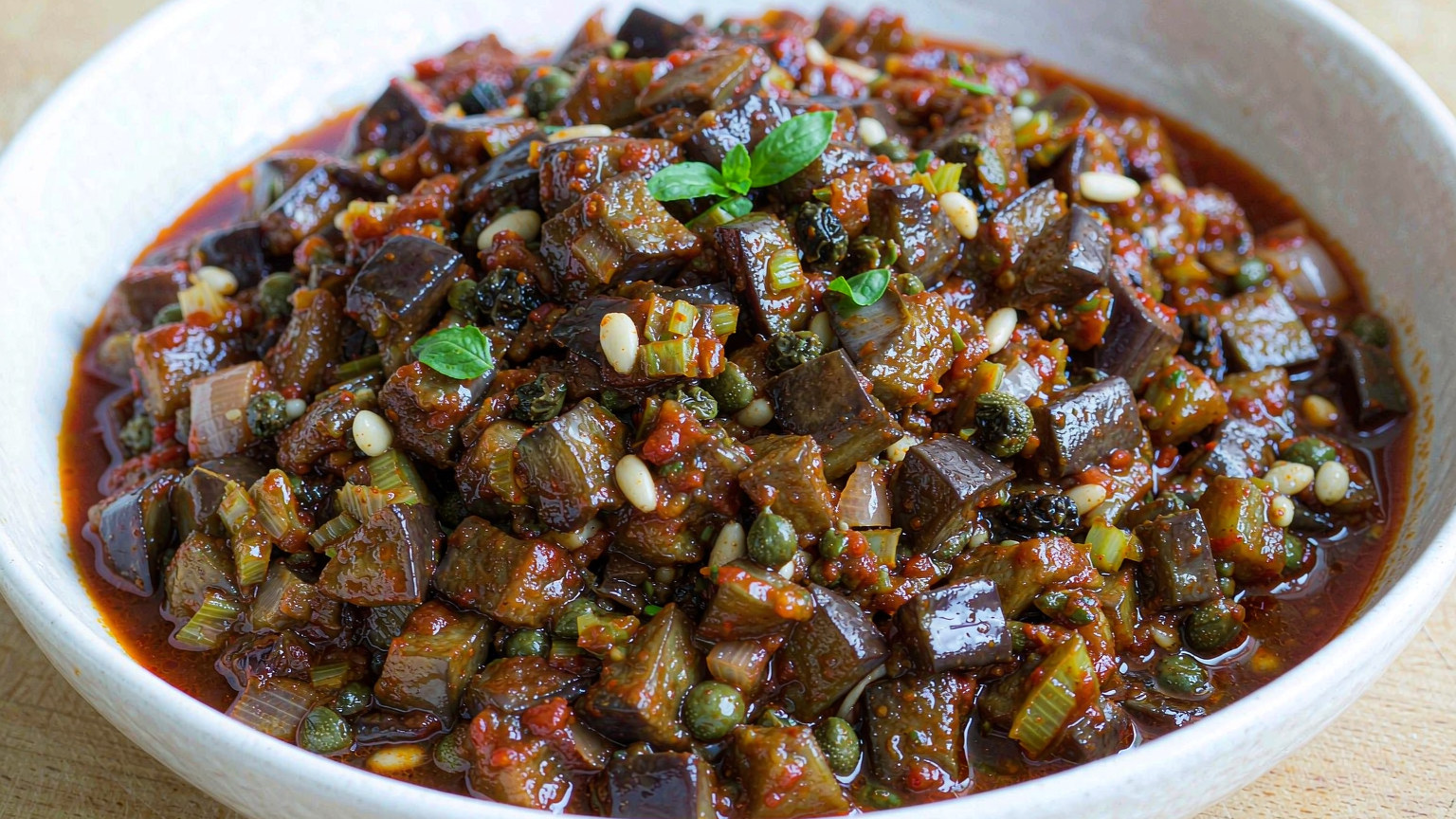
Spoon into a shallow bowl, scatter with the celery leaves and a few basil leaves, and serve with toasted bread. Caponata is at its best the following day, kept covered in the fridge and brought back to room temperature first.
Watch the sweet and sour balance
The useful things to watch are the color of the fried eggplant and the moment the vinegar goes into the tomatoes. Both tell you more than a timer can.
Video embedded from YouTube. The full ingredient amounts and written method are above.
Nutrition in one serving
| Nutrient | Per serving |
|---|---|
| Calories | 210 kcal |
| Protein | 3 g |
| Carbohydrate | 18 g |
| Fat | 15 g |
| Fiber | 6 g |
| Sodium | 640 mg |
Estimates only. Olives, capers and the amount of oil the eggplant absorbs will move the sodium and fat figures the most.
Sweet, sour and silky
Caponata is the opposite of a mild side dish. The first bite is bright and sharp from vinegar and capers, then sweet from the reduced tomato and a little sugar, and finally soft and almost buttery from eggplant that has been properly fried. Nothing should taste raw or harsh. Once it has rested, the sharpness settles into the oil and the whole bowl tastes rounder and deeper.
- Sweet and sour from tomato, sugar and red wine vinegar reduced together until glossy.
- Salty and briny from green olives and capers, which cut through the richness of the fried eggplant.
- Soft but not mushy. Frying the cubes separately keeps their shape and gives them a faintly caramelized edge.
- Fresh and green from basil, celery leaves and toasted pine nuts added at the end.
- Best at room temperature. Cold mutes the vinegar; hot makes the whole dish taste flat.
Cook's notes
- Fry in a single layer. Crowding the pan steams the eggplant and turns it grey and oily.
- Taste the agrodolce before folding. Add vinegar for sharpness or a pinch more sugar for roundness, one teaspoon at a time.
- Caponata keeps for up to four days covered in the fridge. Always bring it back to room temperature before serving.
- Use a firm, glossy globe eggplant. Older, seedy ones taste bitter and break down too fast.
- For a nuttier finish, swap the pine nuts for toasted almonds, or add a spoon of cocoa powder for a darker, richer sauce.
Always cook eggplant until the flesh is completely soft with no firm or raw center. See the food safety guidance in our Terms of Use.
Questions about caponata
What makes an eggplant caponata recipe Sicilian?
The agrodolce balance of vinegar and sugar, plus celery, capers and green olives in a tomato base. It comes from Sicily and is served at room temperature as an antipasto rather than as a hot main course. Other Italian eggplant dishes are usually baked with cheese or simply grilled.
Can I make eggplant caponata ahead of time?
Yes, and it is better that way. Cook it a day ahead, keep it covered in the fridge, and bring it back to room temperature for about 30 minutes before serving. The vinegar and tomato settle into the eggplant overnight.
Why is my caponata too oily?
The eggplant absorbed too much oil because the pan was crowded or the heat was too low. Fry in batches over medium high heat, keep the cubes in one layer, and drain them on paper towels before they go back into the sauce.
Do I have to fry the eggplant for caponata?
Traditional caponata does fry it, and that is what gives the cubes their shape and caramelized edge. You can roast the cubes at 220 C, or 425 F, with a little oil for a lighter version, though the texture will be softer and less distinct.